
How do I create different roles and determine what permissions they have.
Create roles
- Click on “roles” in the side menu on the left under “user management”.
- Here you can see a list with the already existing roles
- Click on the “+” symbol
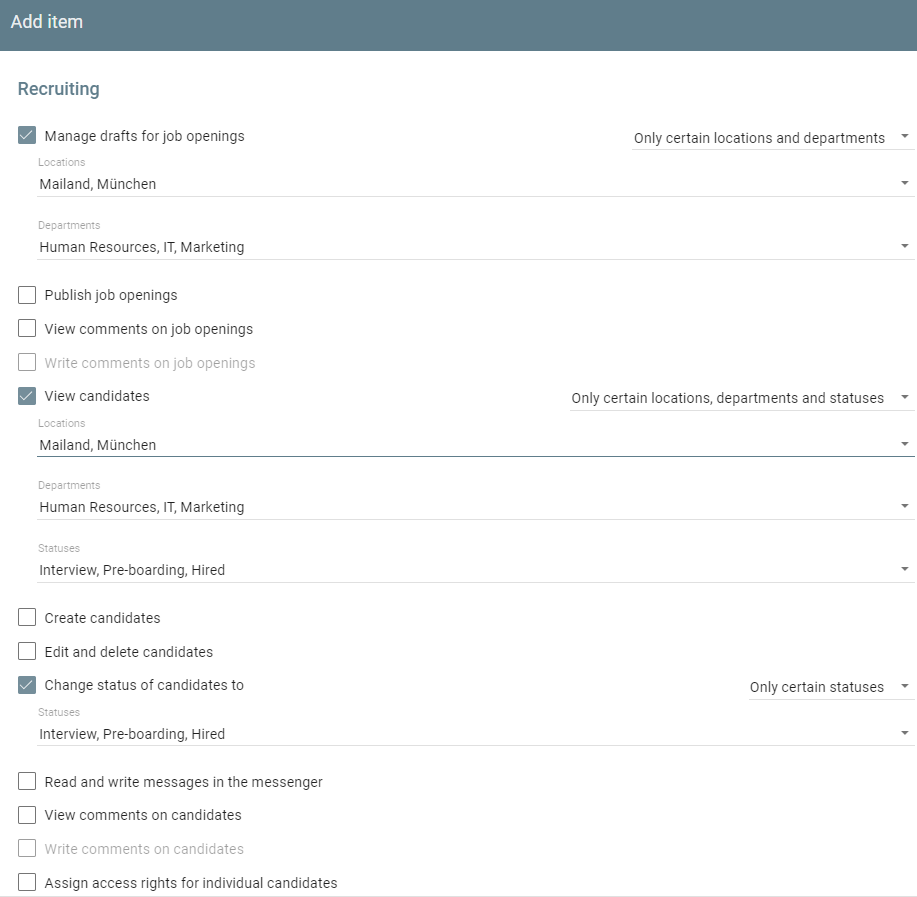
- The pop-up “Add item” appears
- Name your new role
- Assign permissions to your role
- Click on “Save
Permissions
You can customize exactly which permissions a role gets. Roles with the full range of permissions or roles with read-only permissions are possible. Some permissions are bound to each other, the color differentiation in the system helps you to recognize this.
You can also assign permissions individually by department and location (or status). As soon as you have clicked on the selection, a drop-down field appears for this purpose.
Recruiting permissions
Areas, which can be released separately both as read right and edit right:
- View job postings (read right) / Manage job postings (edit right)
With the release of these points, the user concerned has access to the job postings and can create or change them. - View comments on job openings (read right) / Write comments on job openings (edit right)
With the release of these points, the user concerned has access to the comments in the job postings and can enter new comments and mention users. - View candidates (read right) / Create candidates, edit and delete candidates (edit right)
With the release of these points, the user concerned has access to the candidates and can manually create or import them, change them or remove them. - View comments on candidates (read right) / write comments on candidates (edit right)
With the release of these points, the user concerned has access to the comments in the candidate profile and can enter new comments and mention users.
Areas which can only be released as editing rights, because they require actions:
- Perform job posting status changes (edit right)
By enabling this item, the user concerned has the right to change the status of job postings.
The additional restriction ‘Only specific statuses’ defines the initial statuses from which a change of status is permitted. - Delete job postings (edit right)
By enabling this item, the user concerned has the right to delete job postings. - Read and write messages in the messenger (edit right)
By enabling this item, the user is granted access to communicate with candidates via Messenger. - Change status of candidates to (edit right)
By enabling this item, the user concerned has access to the candidates of predefined statuses and can make status changes. - Assign access rights for individual candidates (edit right)
By enabling this item, the concerned user has access to the fifth tag in the candidate profile to create and manage manual access rights for users.
Areas which can be released independently of access to candidates profile:
- View statistics (read right)
With the release of this item, the user concerned has access to the menu item “Statistics” and can view them.
Additional refinements:
When activating almost all items, an additional drop-down appears next to the right, under which further restrictions can be made.
- Restrictions by location, department and/or status
You can clearly define which role has access only to certain departments or even statuses of candidate profiles. - Comment restrictions
The visibility of comments can be set up in addition to the restriction per location, department and status so that only the user’s own comments are visible to him.
Add-on „Employee Referral Program“
The following setting allows you to specify whether the user with the corresponding role can see and manage the rewards.
- View rewards (read right) / Edit and delete rewards (edit right)
With the release of these points, the affected user has access to the rewards and can change or remove them.
Frequently asked questions
Can I release the candidates to the department managers for the specific location and department?
The drop-down fields to the right of the respective rights enable the precise assignment of the visibilities of candidates. This can be structured according to location, department and status. In addition, it is possible to manually enable specific applications for users independently of the access rights granted (see manual access rights).
How can I authorize users to make the general settings of the Recruiting module?
In the roles, the administration of general recruiting settings can be enabled under the “settings” section. This allows the user with this role to make changes to the application form and the fields in the candidates profile, and to adjust the mail templates.